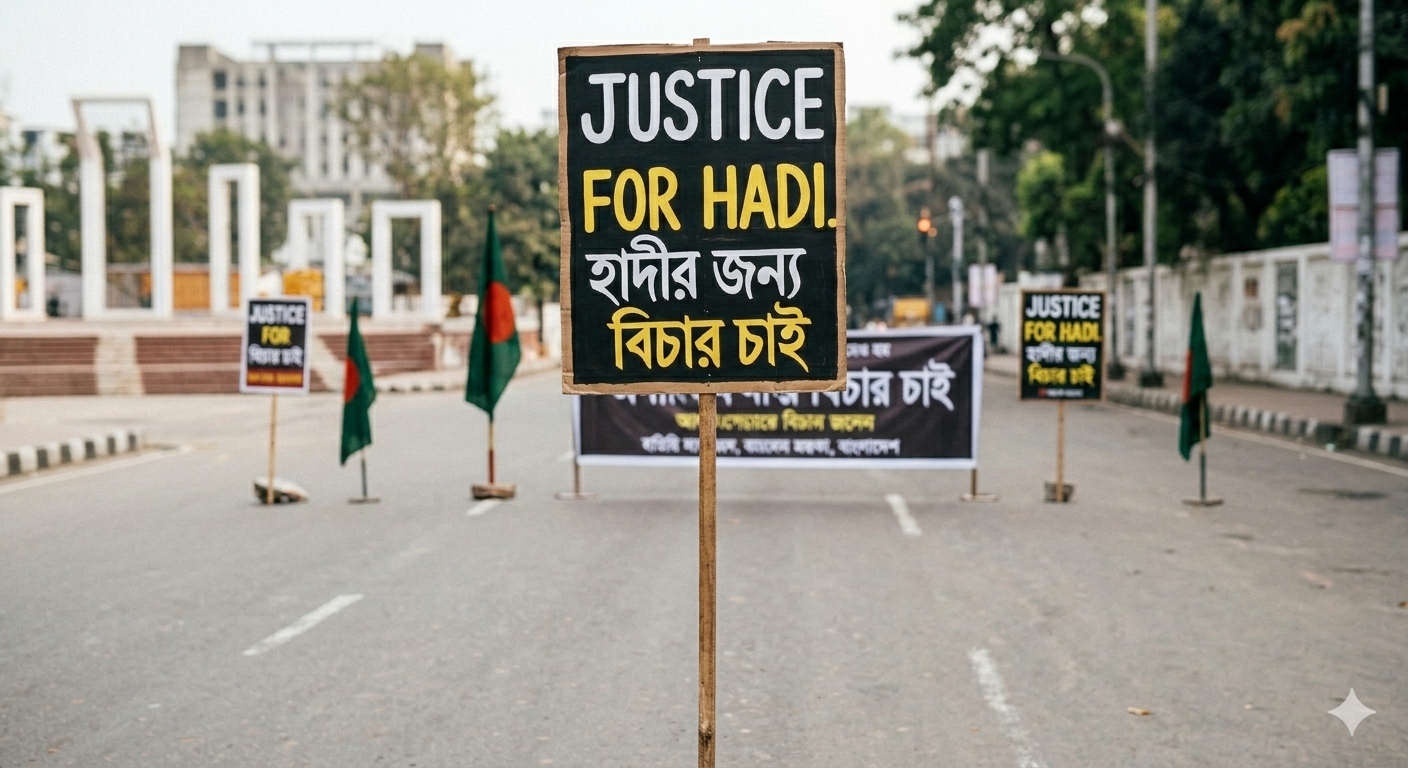
Whenever political violence or murder happens in Bangladesh, we call it “another incident,” another number, another tragedy or another unfortunate but familiar headline. We have normalized the abnormal.
But let’s be clear: this is not random chaos nor a mystery. It is a system functioning exactly as designed. This is not because the country lacks institutions. Bangladesh has a comprehensive legal framework, functioning courts, investigative agencies, and law enforcement structures.
The problem lies not in the absence of law, but in its uneven application. The pattern is predictable. A killing happens, people erupt in anger then starts Hashtags trend on social media, streets fill with people demanding justice, speeches are delivered, promises are made, committees are formed and then silence. The outrage fades. The institutions remain unchanged.
Justice in Bangladesh is not blind, it is selective. It recognizes faces, understands power, and calculates connections. When crimes are tied to influence, investigations slow down. Files move cautiously, procedures stretch endlessly.
On the other hand, when it comes to ordinary citizens’ justice, cases are buried
quickly and quietly.
The message is clear, “Justice is conditional.”
When outcomes depend on proximity to power, the rule of law becomes a performance, courtrooms become stages, accountability becomes an option.
Public anger is loud, but it is short-lived and institutions have learned to wait it out.
They know that rage burns fast.
They know that hashtags expire.
They know that movements exhaust themselves.
So they stall, they delay, and they survive the storm.
And then life returns to “normal” until the next victim.
The deeper problem is not just the violence. It is the structure that allows violence to exist without consequence. We protest the act but rarely sustain pressure against the architecture that allows it.
Police reform is not demanded consistently. Judicial transparency is not enforced. Investigations rarely face strict public deadlines. There is no sustained, organized civic pressure that makes inaction more costly than reform.
“Without accountability, systems do not reform themselves. They protect themselves.” Every unresolved case lowers the cost of the next crime. Every fading protest teaches the powerful that patience is power. And then another name will join the list like Osman Hadi.
The uncomfortable truth is this:
Until law enforcement submits to the law not to the influence.
Until institutions stop bowing to power.
Until citizens demand structural reform instead of symbolic punishment, justice will remain decorative.
Leave a Reply